The following information was provided to Matt Baka of the Planning Department, and Bruce Johnson, the Birmingham Building Official. Their response is below.
In the view of its neighbors, Lutheran Church of the Redeemer, 1800 West Maple, is imposing a light nuisance and disability glare in violation of the following City Zoning Ordinance:
4-21 (LT-01) (B): Light emitted outdoors from any structure will be subject to control by this section if it is determined that it creates a light nuisance[1] and a disability glare[2] as defined by section 9.02 of this ordinance.
Properties regulated by Special Land Use Permits, or SLUP’s, located in single family residential zones must comply with all regulations set forth in this ordinance.
Violations
Church lighting is violating the following Zoning Ordinances:
4-21 (LT-01) (D) General Standards:
(1): All luminaries shall be … positioned in a manner that does not unreasonably invade abutting or adjacent properties.
(3): All luminaries shall use light distribution patterns or positioning that directs light away from adjacent or abutting property when appropriate.
(4): All exterior lighting not deemed necessary for security purposes or architectural enhancement must be turned off during non-business hours and shall be controlled by means of a photocell control, timer, or other acceptable means of control.
4-21 (LT-01) (F) Parking Facilities
(4): All luminaries of a parking facility will use light distribution patterns and/or shielding that directs light away from adjacent or abutting property.
[1] Light Nuisance: Detrimental illuminance within the visual field, that is sufficiently greater than the illuminance to which the eyes are adapted that causes annoyance, discomfort, and is otherwise distressful to surrounding property occupants.
[2] Disability Glare: The effect of stray light in the eye whereby visibility and visual performance are reduced. A direct glare source that produces discomfort may also produce disabling glare by introducing a measurable amount of stray light in the eye.
-----
Response from the Birmingham Planning Dept.
The following is a response from
Matt Baka, of the Planning Department, to questions posed by
Patrick Hillberg, 1853 Fairview
Matt: In regards to your questions, I will attempt to answer each or explain each provision's purpose within the ordinance;
Pat: specifically, per your email you discuss 4-21 (LT-01) (D)(3)Matt: I referenced 4.21 LT-01 (D)4, however 3 would also be taken into consideration when performing a lighting plan review during the approval process.
Did you address each of these, or only make an luminance measurement?My site visit on the evening of the last Planning Board meeting was to take light readings. I had already determined that the type of lights installed (full cut-off wall packs) and location (10' above grade) were in accordance with their SLUP approval on a previous visit.
Did you prepare a report on your findings? I did not prepare a formal report, however I did report back to my supervisor that the light levels did not exceed the levels allowable by ordinance but that they are required to be turned off during non-business hours and that I would contact Redeemer to make sure they were aware of this requirement, which I did.
Where did you measure, and what was the light level? The ordinance states that light levels shall be measured 6' above grade on a vertical plane at the property line. I took my measurements from points along the property line as well as progressively closer to the light fixtures at several points. The levels at the property line were 0.0 fc. The light meter did not register any light reading until I was well with the property line.
4-21 (LT-01) (D): Light emitted outdoors from any structure will be subject to control by this section if it is determined that it creates a light nuisance or disability glare as defined by section 9.02 of this ordinance. (This regards the hallway lighting which shines into our living room.)(4.21 LT-01 B) - This provision is intended to regulate situations such as the one you describe. The night I was out there I did not observe any classroom or hallway lights to be on so I can't speak to whether or not that would constitute a lighting violation. However, I did speak to Steve on that point as well, he said that the cleaning staff is supposed to turn off all the lights once they are finished cleaning for the night.
4-21 (LT-01) (D)(1): all luminaries shall be full cutoff or cutoff, as defined in Section 9.02, and positioned in a manner that does not unreasonably invade abutting or adjacent properties.All the wall packs at Redeemer are full cut-off fixtures and positioned according to the approved plan
4-21 (LT-01) (D)(1)(b): The luminaire is neither obtrusive nor distractingThis provision applies to non-cutoff lights
4-21 (LT-01) (D)(3): All luminaries shall use light distribution patterns or positioning that directs light away from adjacent or abutting property when appropriate.This is done through the use of the cutoff fixtures that direct the light onto the driveway
4-21 (LT-01) (D)(3): All exterior lighting not deemed necessary for security purposes or architectural enhancement must be turned off during non-business hours and shall be controlled by means of a photocell control, timer, or other acceptable means of control.This is the provision I referenced in my last email.
4-21 (LT-01) (E)(1): The intensity of light on a site shall not exceed six-tenths (0.6) maintained foot-candles at any property line that abuts a single family residential zoned propertyThis is the standard that I measured the light levels against. The light levels at the property line registered 0.0 fc
4-21 (LT-01) (F)(4): All luminaries of a parking facility will use light distribution patterns and/or shielding that directs light away from adjacent or abutting property.4-22 (LT-02) (A)(3): All luminaries shall use distribution patterns, shielding or positioning that directs light away from adjacent or abutting property as appropriate.4-22 (LT-02) (A)(4): All lighting shall use appropriate methods to minimize reflection and glare on adjacent or abutting properties.These requirements are met through the use of cutoff fixtures, directional light throws and positioning
All of the standards in the lighting ordinance were based on the IESNA (Illumination Engineering Society of North American) recommended standards (see footnotes in the ordinance)which is considered the authority on these matters. The lighting plan that was approved met the requirements of the Zoning Ordinance. Certainly if the neighbors feel that the lighting is offensive the City will make sure that they (Redeemer) are not violating the ordinance and do our best to work with the stakeholders to resolve the issues. As I mentioned in my previous email, I found Steve to be very receptive to the concerns I voiced to him. I would encourage you to work with him as much as possible, it may just be a matter of him communicating to others at the Church what is required. Please let me know if you have any other questions or if I can be of further assistance.
-----
The Neighbor’s Response
In essence, the neighborhood complaint regarding lighting ordinances is that the Church is not doing all that it can to direct light away from the residential property, when the lights are on, and the lights are on at times when they don’t need to be. (The Church seems to have no regard for the neighborhood aesthetic.) The City’s position is that the Church is using cut-off lighting, but 1) does not seem to be entirely true, especially in the archway lighting on the new west entrance, and 2) focusing strictly on cut-off luminaries ignores the other ordinances mentioned above.
According Matt Baka, the Church is using full cut-off lighting, which is described in the
Zoning Ordinance as:
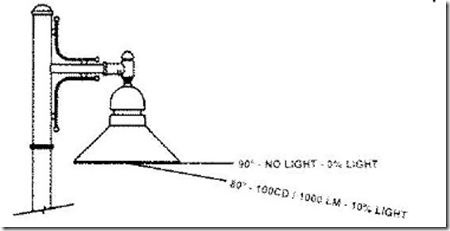
Full Cutoff Luminaire: A luminaire light distribution with zero candela (intensity) at an angle of 90 degrees or above. Additionally, the candela per 1000 lamp lumens does not exceed 100 (10%) at a vertical angle of 80 degrees.
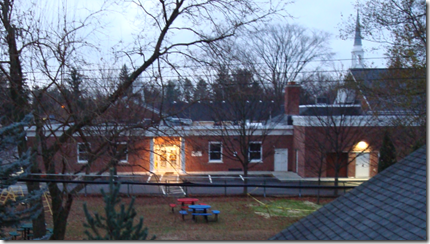
However, this is Church lighting, as viewed from a 2nd story on Fairview. Full cut-off lighting placed at 10’ should generate no light above a 10’ sight line, however, as can be seen here, this is clearly not the case.
There is no question but what this lighting generates a nuisance and a glare, in violation of Zoning Ordinance
4-21 (LT-01) (B)